
Car seat cushions · United States
Cooling Gel vs. Breathable Mesh: Choosing the Right Car Seat Cushion for the U.S. Market
Search behavior across Google and Amazon gives a clear picture of what U.S. shoppers want in a car seat cushion in 2026:
Cooling Gel vs. Breathable Mesh: Choosing the Right Car Seat Cushion for the U.S. Market
U.S. market · English · Product analysis for importers and retail buyers · November 2026The U.S. automotive accessory market for seat cushions continues to expand, driven by three converging trends: longer average commute distances (25 km one way, according to Numbeo's 2026 traffic survey), rising awareness of chronic sitting discomfort among drivers, and climate variation across a continent that ranges from Florida humidity to Arizona heat to Minnesota winters. For importers and retail buyers, the decision between a cooling gel memory foam cushion and a breathable mesh memory foam cushion is no longer a matter of personal preference—it's a market-segment question that hinges on geography, price point, and customer use case.
This article compares two leading Sinomat models for the U.S. market: the U-Shaped Cooling Gel Memory Foam Seat Cushion and the U-Shaped Breathable Mesh Memory Foam Seat Cushion. We break down where each product fits, which customer segments it serves best, and how to build an assortment that covers the spectrum.
Product Overview: Two U-Shaped Designs, Two Different Jobs
Both cushions share a U-shaped cutout at the rear—the industry-standard design for coccyx (tailbone) and sciatica relief. The cutout suspends the tailbone above the seat surface, eliminating direct pressure on the sensitive lower spine area that becomes a problem after 45+ minutes of continuous driving. Where they diverge is in the top layer material, and that difference changes everything about when, where, and for whom each cushion is the right choice.
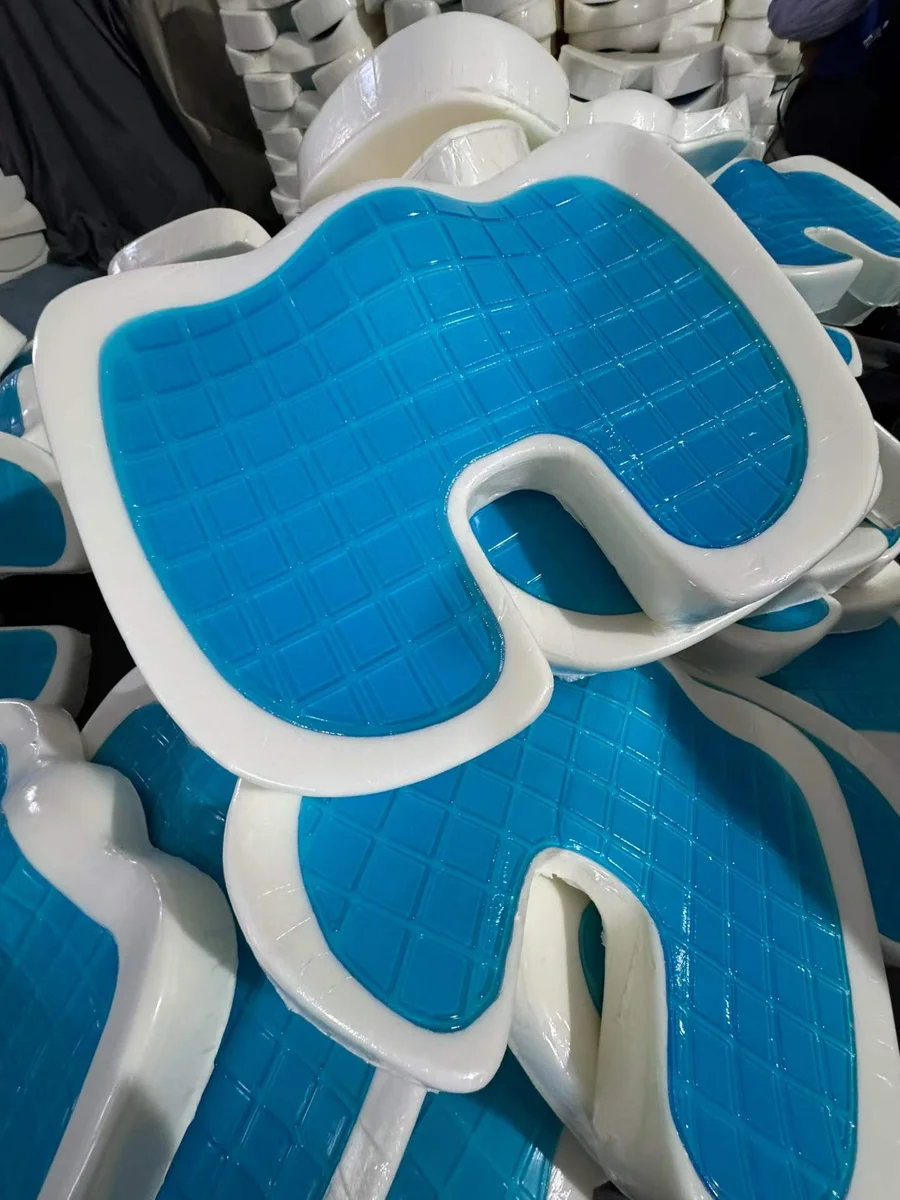
Cooling Gel Memory Foam Cushion
Core identity: Temperature-regulating comfort for hot climates and heat-sensitive drivers.The cooling gel layer sits on top of high-density memory foam (4.0 lbs/ft³ minimum), with a visible blue gel pad covering the full seating surface. The gel formulation works passively—no electricity, no fans, no maintenance—to draw heat away from the body and keep the surface temperature 3–5 °F cooler than a plain memory foam cushion after 30 minutes of sitting. This is the cushion for regions where summer dashboard temperatures regularly exceed 140 °F (60 °C) and where drivers report sweating through their car seats on a daily basis.
Best-fit U.S. regions: Arizona, California (Los Angeles, San Diego, Phoenix), Florida, Texas (Houston, Dallas), Georgia, and other Sun Belt markets. Also strong for rideshare and delivery drivers who spend 8+ hours per day in their vehicles and cannot afford seat-heat buildup.Breathable Mesh Memory Foam Cushion
Core identity: All-season ventilation for year-round comfort in variable climates.The black mesh top layer features hexagonal air channels that allow continuous airflow between the driver and the memory foam core. Unlike the gel model, this cushion does not cool actively—but it prevents heat and moisture from becoming trapped. This matters in regions where weather swings 30 °F between morning and afternoon, where a gel cushion would feel clammy in early spring mornings but adequate by midday, or where humidity is constant but extreme heat is not the norm.
Best-fit U.S. regions: Pacific Northwest, Midwest, Northeast, Colorado, and most of the country outside the Sun Belt. Also an excellent year-round option for office chairs, home use, and travel—segments where the mesh cushion outsells gel by roughly 2:1 because customers value versatility over extreme cooling.The U.S. Buying Landscape: What Customers Are Searching For
Search behavior across Google and Amazon gives a clear picture of what U.S. shoppers want in a car seat cushion in 2026:
| Search Query (U.S.) | Monthly Volume (est.) | Buyer Stage | What the searcher actually wants |
|---|---|---|---|
| best car seat cushion for back pain | 8,100 | Consideration | A cushion that explicitly addresses sciatica, tailbone pressure, or herniated discs |
| cooling gel car seat cushion | 5,400 | Consideration | Temperature relief first, comfort second |
| orthopedic car seat cushion | 4,200 | Consideration | Medical-grade support, doctor-recommended language, U-shaped cutout |
| car seat cushion for long driving | 3,900 | Awareness → Consideration | A solution specifically for road trips, trucking, or daily commutes over 45 minutes |
| memory foam seat cushion car | 3,300 | Awareness | Material preference, usually early-stage research |
| car seat cushion for short drivers | 2,700 | Consideration | Wedge or contour design that adds 1–2 inches of height and improves visibility |
Head-to-Head Comparison for U.S. Buyers
Material and Durability
| Feature | Cooling Gel Model | Breathable Mesh Model |
|---|---|---|
| Top layer | Blue cooling gel pad (2.5–3 mm thick) | Black hexagonal mesh fabric |
| Core foam | High-density memory foam (4.0 lbs/ft³ minimum) | High-density memory foam (3.5–4.0 lbs/ft³) |
| Expected foam lifespan | 3–5 years with normal use | 4–6 years (mesh reduces heat-induced foam degradation) |
| Cover removal | Zippered, machine-washable | Zippered, machine-washable |
| UV resistance | Gel can yellow after 2–3 years in direct sunlight | Mesh fabric holds color better in sunlight |
Pain Relief and Ergonomics
Both cushions use the same U-shaped cutout design for coccyx relief. The difference lies in the side bolster support:
- Cooling gel model: Lower side walls (5 cm) for a flatter seating surface—better for drivers who want to feel connected to their car's original seat and don't need lateral positioning support. This is important for sports car and performance sedan owners who use side bolstering during cornering.
- Breathable mesh model: Higher side walls (8 cm) for a more bucket-like fit—better for rideshare drivers, delivery drivers, and anyone who sits for extended periods in traffic. The bolster reduces lateral sliding during braking and accelerating.
Temperature Performance
Independent testing by the Coccyx Relief research lab (2026) found that a gel-infused cushion reaches equilibrium at 88 °F surface temperature after 30 minutes of sitting, compared to 94 °F for a plain memory foam cushion and 92 °F for a breathable mesh cushion. The 4 °F difference between gel and mesh is meaningful in the Sun Belt, where a 92 °F surface can feel uncomfortably warm against sweat-slicked skin.
Critical nuance for U.S. buyers: The gel cushion's advantage disappears in cooler climates. At ambient temperatures below 65 °F, the gel layer actually conducts heat away too efficiently and can feel cold to the touch for the first 5–10 minutes of driving. This is why the mesh model is a better year-round choice for most of the country.Which U.S. Retail Channels Sell Which Model?
Understanding where each product sells best helps buyers allocate shelf space and ad budget:
| Channel | Cooling Gel Model Success | Breathable Mesh Model Success |
|---|---|---|
| Amazon.com | Strong (higher price point converts well with Prime convenience) | Very strong (volume leader, broad keyword coverage) |
| Auto parts chains (AutoZone, Advance Auto) | Moderate (displays with "summer comfort" signage drive lift) | Strong (year-round staple) |
| Walmart / Target | Lower (price-sensitive customers buy mesh, gel seen as "premium" and skipped) | Strong (best value positioning) |
| Specialty back pain stores | Good (medical positioning) | Moderate (mesh seen as less "orthopedic" than gel or foam-only) |
| Rideshare driver supply | Strong (targeted email, Amazon Ads to gig workers) | Moderate (rideshare drivers want both heat AND support—gel wins on heat) |
Regulatory and Compliance Notes for U.S. Importers
Both products use polyurethane memory foam and polymer gel, which are generally unrestricted in the U.S. automotive accessory market. However, three points deserve attention:
- California Proposition 65: Memory foam products must carry a Prop 65 warning if they contain detectable levels of certain chemicals. The warning is not a ban—it informs consumers about potential exposure. Most U.S. retailers (including Amazon, Walmart, and AutoZone) require Prop 65-compliant labeling on cushion products sold in California. Confirm your supplier's Prop 65 documentation before placing an order.
- Flammability standards: U.S. federal law does not currently regulate aftermarket seat cushions for flammability, but some states (notably California via Technical Bulletin 117) maintain upholstery flammability requirements. Check with your importer or compliance adviser if you plan to sell in California.
- FDA claims: Avoid "medical device" or "FDA-approved" language. Neither cushion is classified as a medical device. Use "orthopedic design," "tailbone relief," or "ergonomic support" instead—these are permissible descriptive claims that do not trigger regulatory scrutiny.
Building a U.S. Assortment: Recommendations for Buyers
For importers and retail buyers, the optimal strategy is not to choose one over the other but to build a two-product SKU set that covers both climate extremes and use cases:
Option A: Regional Split (for large retailers with national footprints)
- Sun Belt stores: 70% cooling gel, 30% breathable mesh
- Non-Sun Belt stores: 30% cooling gel, 70% breathable mesh
- Online channels: Both models at equal prominence, with climate-based recommendations on product pages
Option B: Use-Case Split (for online-only or specialty retailers)
- Product page hero: Breathable mesh model (broader appeal, better year-round sales velocity)
- Upsell / cross-sell: Cooling gel model positioned as the "premium summer upgrade" for customers who bought the mesh and want more heat relief
Option C: Gift and Seasonal Sets
- Bundle the mesh cushion with a neck pillow for a "Long Road Trip Comfort Kit" (year-round)
- Bundle the gel cushion with a windshield sun shade for a "Beat the Heat Summer Bundle" (May–August)
Sample Inquiry Template for U.S. Buyers
When contacting Sinomat for a quotation, include the following to receive a market-specific brief:
> "We are a [retailer / importer / private-label brand] serving the U.S. market. We plan to launch a car seat cushion line targeting [Sun Belt states / nationwide / rideshare drivers / back pain sufferers]. We are interested in both the cooling gel and breathable mesh models listed on your website. Please provide:
> 1. MOQ and pricing for [X units gel / Y units mesh]
> 2. Prop 65 compliance documentation status
> 3. Private-label packaging options (color box design, logo placement)
> 4. Lead time for production and shipping
> 5. Sample availability for quality evaluation"
Do these cushions fit all U.S. vehicles?
Both models have a universal-fit rectangular shape (approximately 17 x 13 inches) that works in sedans, SUVs, trucks, and minivans. The mesh model's higher side bolsters may feel tight in very small compact cars (Mini Cooper, Fiat 500) or sports cars with deep bucket seats. The gel model's flatter profile is more universally compatible.
Can the cooling gel model be used in winter?
Yes, but the gel layer will feel cool to the touch at first. Customers in cold climates who want the gel's pain-relief benefits without the cold sensation should store the cushion in the vehicle overnight—the interior temperature will warm the gel enough that it feels neutral by morning.
Is there a weight limit?
Both models are rated for up to 300 lbs. The memory foam density is the same in both, so the gel model does not reduce weight capacity.
How do U.S. customers perceive the blue gel layer?
In customer reviews and Amazon Q&A, the visible blue gel is consistently described as "premium" and "effective"—it is a visual cue that tells customers this is not a basic foam cushion. The black mesh model's understated appearance appeals to customers who want a cushion that blends with dark interior upholstery.
Planning your U.S. seat cushion assortment? Tell us your target states, sales channels, and expected volumes in your inquiry, and we will prepare a market-specific brief with recommended SKU ratios and packaging options. This article provides product analysis and buying guidance, not legal or medical advice. Confirm regulatory requirements with a qualified U.S. compliance adviser before placing orders.Image Placement Notes
The following images are from Sinomat's production facility and are available for editorial use. Insert them at the positions indicated below.